
One of my best friends asked me if I had an installer for an old Web browser at hand, since he was building up a retro computing system. It made me think about my first contact with the Internet, and how different it was then compared to now.
I’d really like to eventually write some sort of long-form essay, or possibly even a short book or pamphlet, on what the Internet of the mid to late 1990s was like. But right now, I’m on a blog, so I’ll keep it a bit shorter than that!
Turning on the computer.
In the heady, bygone days of the 1990s, computers were not something you just picked up and had running. You had to turn them on, and wait for them to start up. It was quite an occasion, really; the hard disks were loud, as were the fans on some models. You felt a sort of power making one of these beasts whirl to life.
Then you spent about 30 seconds staring at either a Mac or Windows logo screen, while the computer loaded everything. It’s sort of like how you see the Windows flag or Apple logo during a software update nowadays – only that was every time you turn the computer on.
Connecting to the Internet.
Also, back then, there was no Wi-Fi. Seriously! The Apple iBook is widely hailed as the first computer to be sold with Wi-Fi, and it debuted in July of 1999. (Special enterprise gear had it as early as 1997, but pretty much no home did.)
We plugged our telephone wire directly into the computer – and yes, back then telephones used wires – and the computer dialled out. If you’ve ever had the “pleasure” of hearing a fax machine running, it sounded somewhat like that. Your computer rang a computer at your ISP, and they exchanged information which established the network connection. And then you had access to the Internet!
What was on there, anyway?
This may sound odd, but there was both “a lot more”, and “a lot less”, compared to today’s Internet. There were far less advertisements, and of course there was no “AI slop” as LLMs were 25-30 years from being invented. It felt organic to browse and get lost “surfing”. You can get some of the same feeling clicking random Wikipedia articles (or using something like WikiScroll), but this was the whole Web.
We had chat rooms, but they weren’t really like Discord or Messenger or WhatsApp. There were no GIFs, no reactions, and emojis were textual: :) instead of 🙂, for instance. And yet, the chat rooms were more lively, and at least from my perspective, it seems like there were a wider number of interests represented. I don’t see many Discords about cooking, or WhatsApps about local sports teams. Then again, perhaps I’m just not cool enough to be invited to them. (Feel free to send me a link to an Arsenal fans guild.) But those were the sorts of chat rooms we had. That’s how communities were built then: shared interests and common bonds.
I will admit that I do see this happening again with some of the modern chat platforms, which has been lovely to watch. The social media fads of the 2010s really didn’t do it for me.
And around the turn of the millennium, we did have a primitive form of streaming! I recently dug this screenshot up, and it was taken in the autumn of 2001. Behold, Gen X streaming:
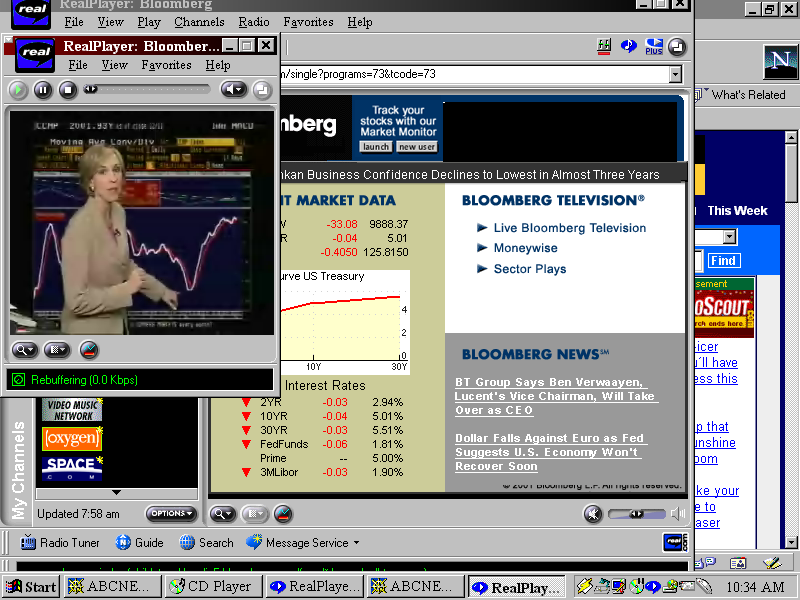
It was a lot like what happens if you are buffering a video in the middle of nowhere and you have bad mobile service. Choppy, blocky, and with audio that has that distinct echo and hum.
This sounds terrible! How is this nostalgic?
I remember this era of the Internet fondly not because of the bad qualities, but because of the foundational goodness. Everything you could like about the modern Web was there: communities, exploration, excitement, connection – but without all the trappings of late-stage capitalism, artificial competition, and corporate washing.
The restrictions of the older technology also made us more creative with what we did with it. I learned different ways of saving data to make it fit on smaller disks, and that knowledge has served me well all these years later. Pixel art was a skill you needed back then to make any sort of creative graphical work, and is still great fun to do now.
I hope this little journey through the past was as fun for you to read as it was for me to write. Until later, enjoy yourself, dear reader!